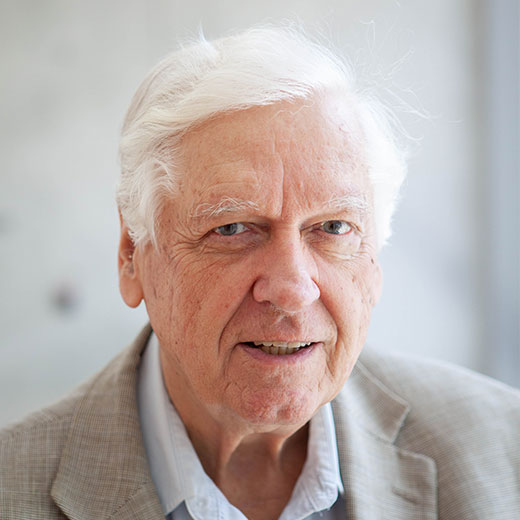
Hamilton Smith, MD

Distinguished Professor Emeritus

Hamilton Smith, M.D. is a distinguished professor emeritus at the J. Craig Venter Institute and former director of the Synthetic Biology and Bioenergy Group that created the first synthetic cell in 2010 and designed and synthesized the first minimal bacterial genome in 2016. He received an A.B. degree in Mathematics from the University of California, Berkeley in 1952 and the M.D. degree from the Johns Hopkins School of Medicine in 1956. He completed a residency in Internal Medicine in 1962. From 1962-67, he did research on lysogeny in phage P22 at the University of Michigan. In 1967, he was appointed Assistant Professor of Microbiology at Johns Hopkins. In 1970, he discovered the first Type II restriction enzyme, HindII. He received the Nobel Prize in Medicine in 1978 for that work. From 1975 to 1998, he studied the DNA transformation mechanism in Haemophilus Inflluenzae Rd. In 1993, Dr. Smith began his long association with Craig Venter. In 1995, they collaborated to sequence the genome of H. Inflluenzae Rd, and from 1998 to 2002, at Celera Genomics they sequenced Drosophila and the human genome. After leaving Celera, Smith and Venter began their work in synthetic biology.

Research Priorities

Deciphering the genetic requirements for minimal bacterial life
  • Assignment of genetic functions to unknown genes in the minimal cell by computational, biochemical and genetic methods.
Designing a minimal yeast cell
  • Determining non-essential genes by global DNA cassette insertional mutagenesis.
Understanding the mechanism of DNA cassette insertional mutagenesis in yeast
  • Genetic and biochemical analysis of the DNA insertion mechanism.
Salk Intitute Lecture — 2016 DOE JGI Genomics of Energy & Environment Meeting
Johns Hopkins Medicine — The Hamilton Smith Award for Innovative Research
UW-Madison Lecture
Salk Intitute Lecture — Making miniature machines - with Hamilton Smith
The Nobel Prize — Interview with Hamilton Smith and Richard Roberts
28-Oct-2025
News Alert

Remembering Hamilton O. Smith

22-Dec-2020
Press Release

Hamilton O. Smith, M.D., Synthetic Biology Pioneer and Nobel Laureate, to Step Down from Daily Duties at J. Craig Venter Institute

Dr. Smith will maintain advisory role as professor emeritus

19-Dec-2020
The San Diego Union-Tribune

After saving countless lives, Nobel laureate Hamilton Smith retires as his own health falters

He has been a fixture in San Diego science for decades

13-Jun-2012
Press Release

JCVI Researchers, as Part of NIH Human Microbiome Project Consortium, Publish Papers Detailing the Variety and Abundance of Microbes Living on and in the Human Body

Study Represents Largest Group of Healthy Individuals Studied to Date

JCVI also Details its Metagenomics Reports (METAREP) Open Source Bioinformatics Tool

20-Aug-2009
Press Release

J. Craig Venter Institute Researchers Clone and Engineer Bacterial Genomes in Yeast and Transplant Genomes Back into Bacterial Cells

New methods allow for the rapid engineering of bacterial chromosomes and the creation of extensively modified bacterial species; should also play key role in boot up of synthetic cell

24-Jan-2008
Press Release

Venter Institute Scientists Create First Synthetic Bacterial Genome

Publication Represents Largest Chemically Defined Structure Synthesized in the Lab

Team Completes Second Step in Three Step Process to Create Synthetic Organism

28-Jun-2007
Press Release

JCVI Scientists Publish First Bacterial Genome Transplantation Changing One Species to Another

Research is important step in further advancing field of synthetic genomics

29-Sep-2004
Press Release

J. Craig Venter Announces Consolidation of Three Research Organizations Into One New Not-For-Profit Organization — The J. Craig Venter Institute

The Center for Advancement of Genomics (TCAG), Institute for Biological Energy Alternatives (IBEA), and J. Craig Venter Science Foundation Joint Technology Center (JTC) consolidated to form J. Craig Venter Institute

13-Nov-2003
Press Release

IBEA Researchers Make Significant Advance in Methodology Toward Goal of a Synthetic Genome

Group Synthesizes Biologically Active Genome of Bacteriophage φX174

IBEA research, funded by Dept. of Energy, is an important advance toward the goal of a completely synthetic genome that could aid in carbon sequestration and energy production

21-Nov-2002
Press Release

IBEA Receives $3 Million Dept. of Energy Grant for Synthetic Genome Development

Hamilton Smith, M.D., Nobel Laureate, Named Scientific Director of IBEA