First Minimal Synthetic Bacterial Cell
Overview
Researchers from the J. Craig Venter Institute (JCVI) and Synthetic Genomics, Inc. (SGI) have accomplished the next feat in synthetic biology research—the design and construction of the first minimal synthetic bacterial cell, JCVI-syn3.0.
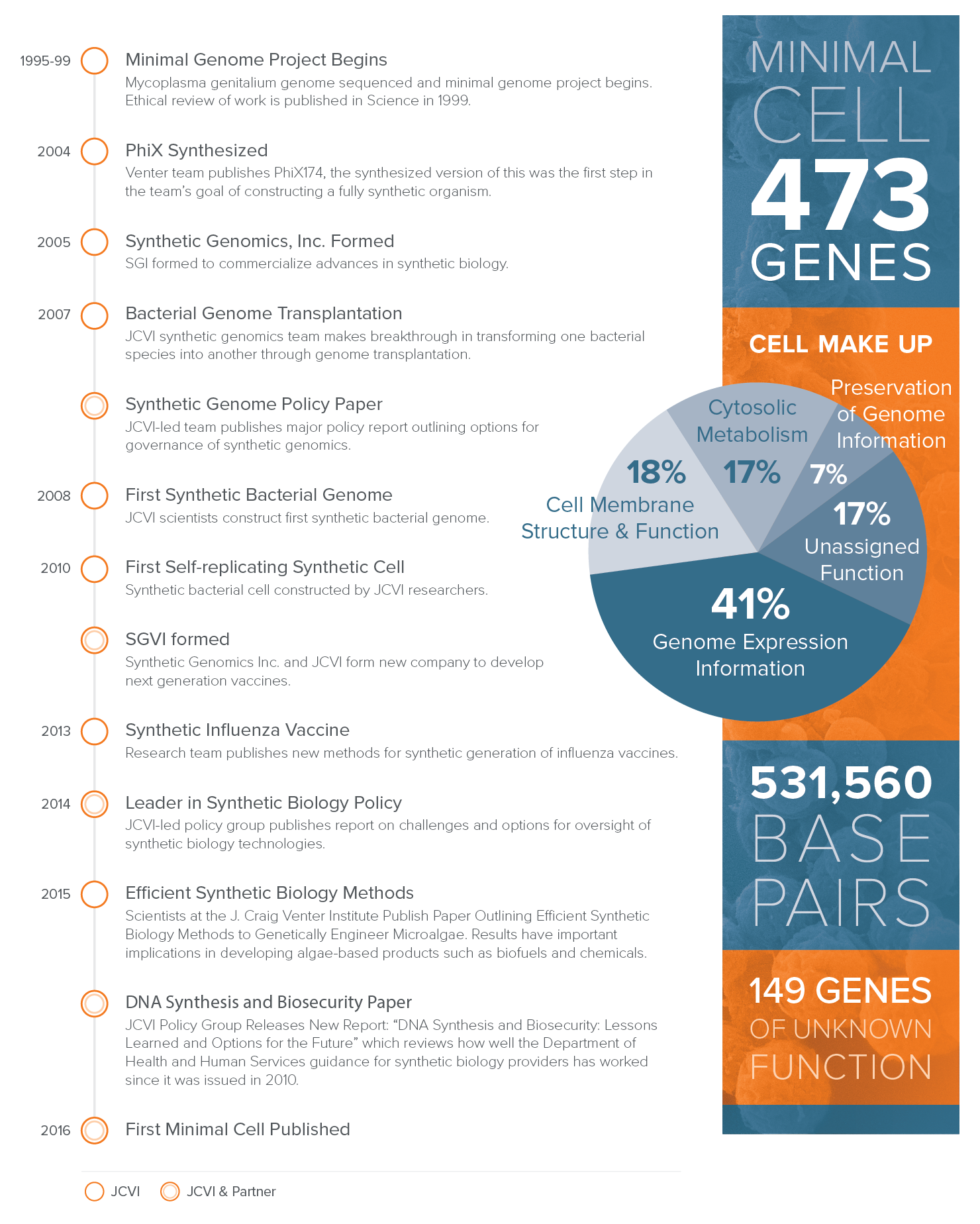
Using the first synthetic cell, Mycoplasma mycoides JCVI-syn1.0 (built by this same team in 2010), JCVI-syn3.0 was developed through a design, build, and test (DBT) process using genes from JCVI-syn1.0. The new minimal synthetic cell contains only 531,000 base pairs and just 473 genes making it the smallest genome of any self-replicating organism.
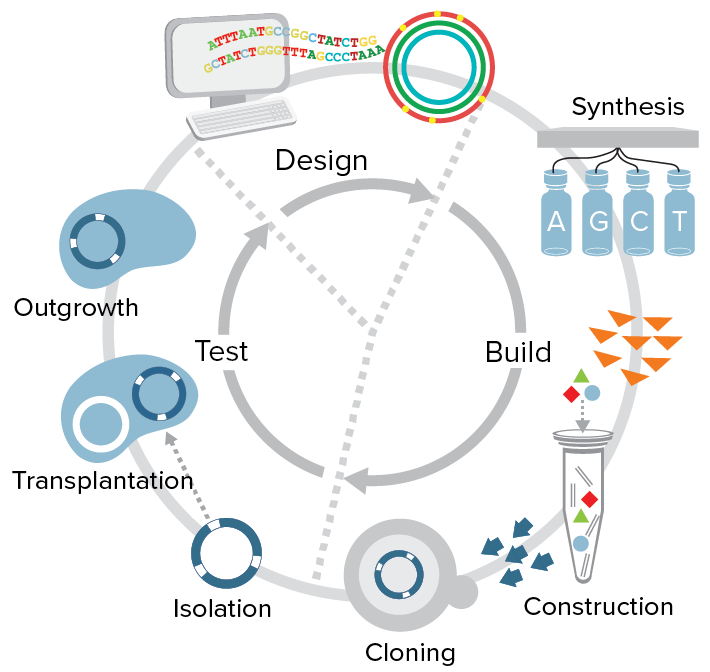
A paper describing this research is published in the March 25 print version of the journal, Science by lead author Clyde A. Hutchison, III, PhD, senior author J. Craig Venter, PhD, and senior team of Hamilton O. Smith, MD, Daniel G. Gibson, PhD, and John I. Glass, PhD.
Writing Biological Code
A biological cell is very much like a computer—the genome is the software that encodes the instructions of the cell and the cellular machinery is the hardware that interprets and runs the genome software. Major advances in DNA technologies have made it possible for biologists to now behave as software engineers and rewrite entire genomes to program new biological operating systems.
Project Goals
A major goal in synthetic biology is to have the capacity to predictably design and build DNA that produces a cell with new and improved biological functions that do not already exist in nature. Significant advances have been made in DNA design at the gene and pathway level and in engineering bacteriophage genomes. But, even with all the advances that have been made in genomics and synthetic biology, there is still not a single self-replicating cell in which we understand the function of every one of its genes. Toward this goal, the JCVI/SGI team has been working to understand the gene content of a minimal cell—a cell that has only the machinery necessary for independent life.
Since the generation of the first synthetic cell in 2010, the team found ways to drastically speed up the process of building cells from the bottom up. They developed new tools and semi-automated processes for genome synthesis, including more rapid, more accurate, and more robust methods for going from oligonucleotides (small pieces of DNA) to whole chromosomes. Over the past 10 years whole bacterial chromosome assembly has gone from impossible, to possible in years, to months and now to just weeks with these new methods, which are made available to scientists in this manuscript.
A major outcome of this minimal cell program has been new tools and semi-automated processes for whole genome synthesis. Many of these synthetic biology tools and services are commercially available through SGI-DNA.
Milestones in JCVI Synthetic Biology Research and Policy
Funding
This work was funded by SGI, the JCVI endowment and the Defense Advanced Research Projects Agency’s Living Foundries program, HR0011-12-C-0063.
Related Information
Principal Investigator
Note on Data
The JCVI-syn3.0 sequence has been deposited in Genbank under the accession number CP014940. You can access the supplementary material for the paper by clicking on the link at the end of the text. Note that in addition to Materials and Methods, Supplementary Figures, Supplementary Tables, and References, there is also a link to an Excel Spreadsheet named Database S1. This spreadsheet gives detailed information about the genes of JCVI-syn3.0. The coordinates of each gene on the M. mycoides JCVI-syn1.0 sequence are listed (Genbank accession number CP002027). There is also information about gene annotation, and a column listing the complete amino acid sequence of each protein gene product.
Related Research
Related
Publications
Publications
Cell. 2026-03-09;
Bringing the genetically minimal cell to life on a computer in 4D
iScience. 2023-09-15; 26.9: 107500.
Adaptive evolution of a minimal organism with a synthetic genome
Nature. 2023-07-05;
Evolution of a minimal cell
ACS synthetic biology. 2023-06-16; 12.6: 1616-1623.
Cell-Free Expression System Derived from a Near-Minimal Synthetic Bacterium
Trends in cell biology. 2022-11-01; 32.11: 900-907.
Cellular mechanics during division of a genomically minimal cell
mBio. 2022-08-30; 13.4: e0163022.
Metabolite Damage and Damage Control in a Minimal Genome
Cell. 2022-07-21; 185.15: 2708-2724.
Synthetic chromosomes, genomes, viruses, and cells
Cell. 2022-01-20; 185.2: 345-360.e28.
Fundamental behaviors emerge from simulations of a living minimal cell
Cell. 2021-04-29; 184.9: 2430-2440.e16.
Genetic requirements for cell division in a genomically minimal cell
eLife. 2019-01-18; 8.
Essential metabolism for a minimal cell
Science (New York, N.Y.). 2016-03-25; 351.6280: aad6253.
Design and synthesis of a minimal bacterial genome
Related Information
Principal Investigator
Note on Data
The JCVI-syn3.0 sequence has been deposited in Genbank under the accession number CP014940. You can access the supplementary material for the paper by clicking on the link at the end of the text. Note that in addition to Materials and Methods, Supplementary Figures, Supplementary Tables, and References, there is also a link to an Excel Spreadsheet named Database S1. This spreadsheet gives detailed information about the genes of JCVI-syn3.0. The coordinates of each gene on the M. mycoides JCVI-syn1.0 sequence are listed (Genbank accession number CP002027). There is also information about gene annotation, and a column listing the complete amino acid sequence of each protein gene product.
Related Research
Related
News
Team simulates a living cell that grows and divides
Opentrons Announces New Robotics Education Initiative Demonstrating Commitment to Laboratory Automation for Students
12th Build-a-Cell Workshop hosted at J. Craig Venter Institute in La Jolla
The workshop will take place March 29, 2024 with registration closing March 19
Bringing cells to life … and to Minecraft: $30 million NSF grant to support whole-cell modeling at the Beckman Institute
Beckman researchers and collaborators received $30 million from the U.S. National Science Foundation to establish the NSF Science and Technology Center for Quantitative Cell Biology. The center will develop whole-cell models to transform our understanding of how cells function and share that knowledge with diverse communities through the popular computer game Minecraft.
Lessons from the Minimal Cell
“Despite reducing the sequence space of possible trajectories, we conclude that streamlining does not constrain fitness evolution and diversification of populations over time. Genome minimization may even create opportunities for evolutionary exploitation of essential genes, which are commonly observed to evolve more slowly.”
Even Synthetic Life Forms With a Tiny Genome Can Evolve
By watching “minimal” cells regain the fitness they lost, researchers are testing whether a genome can be too simple to evolve.
Artificial cells demonstrate that “life finds a way”
Scientists Create the Smallest-Ever Moving Cell
Just two genes get tiny synthetic cells moving, offering clues to life’s evolution.
Synthesizing life on the planet
What’s the smallest number of genes that cells need to grow and reproduce? Is it possible to synthesize minimal genomes and insert them into cells? What do minimal genomes teach us about life? An interview with John Glass, Ph.D.
Synthetic genomics advances and promise
Advances in DNA synthesis will enable extraordinary new opportunities in medicine, industry, agriculture, and research
Scientists develop most complete whole-cell computer simulation model of cell to date
J. Craig Venter Institute model organism-minimal cell platform provides robust tools for exploring first principles of life, design tools for genome
Genes necessary for cell division in modern bacterial cells identified
Discovery may help shape understanding of primitive cell division
2019 Summer Internship Program
JCVI Team Awarded Two Grants Under the National Science Foundation’s “Understanding the Rules of Life” Initiative, Building on 20 Years of JCVI Research
First Minimal Synthetic Bacterial Cell Designed and Constructed by Scientists at Venter Institute and Synthetic Genomics, Inc.
Cell, JCVI-syn3.0, was minimized to just 473 genes
First Self-Replicating, Synthetic Bacterial Cell Constructed by J. Craig Venter Institute Researchers
Scientist Spotlight: Hamilton O. Smith and Clyde A. Hutchison III
J. Craig Venter Institute Researchers Clone and Engineer Bacterial Genomes in Yeast and Transplant Genomes Back into Bacterial Cells
New methods allow for the rapid engineering of bacterial chromosomes and the creation of extensively modified bacterial species; should also play key role in boot up of synthetic cell
J. Craig Venter Institute Researchers Publish Significant Advance in Genome Assembly Technology
Advance Allows for More Efficient Construction of Synthetic Genomes
Venter Institute Scientists Create First Synthetic Bacterial Genome
Publication Represents Largest Chemically Defined Structure Synthesized in the Lab
Team Completes Second Step in Three Step Process to Create Synthetic Organism
JCVI Scientists Publish First Bacterial Genome Transplantation Changing One Species to Another
Research is important step in further advancing field of synthetic genomics
IBEA Researchers Make Significant Advance in Methodology Toward Goal of a Synthetic Genome
Group Synthesizes Biologically Active Genome of Bacteriophage φX174
IBEA research, funded by Dept. of Energy, is an important advance toward the goal of a completely synthetic genome that could aid in carbon sequestration and energy production
IBEA Receives $3 Million Dept. of Energy Grant for Synthetic Genome Development
Hamilton Smith, M.D., Nobel Laureate, Named Scientific Director of IBEA