Related
Bio
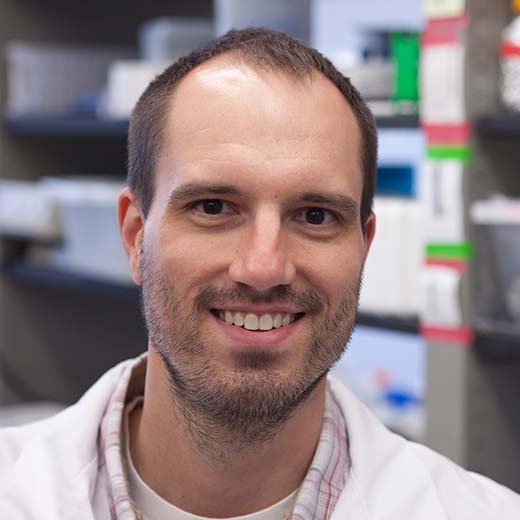
Daniel Gibson is an Professor in the Synthetic Biology group at the JCVI. Since joining the JCVI as a postdoc in 2004, Gibson led the JCVI efforts to synthesize two complete bacterial genomes. Those projects resulted in creation of the first synthetic bacterial cell and development of an enabling suite of DNA synthesis and assembly methods.
Prior to joining the JCVI, Gibson earned his PhD in Molecular Biology from the University of Southern California. While there, he used yeast as the model system for studying cell cycle surveillance mechanisms (checkpoints), which are significant in our understanding of cancer development. Before earning his Ph.D., he earned his Bachelor's degree in Biological Sciences from the State University of New York at Buffalo.
Publications
Publications
Chromosome research : an international journal on the molecular, supramolecular and evolutionary aspects of chromosome biology. 2025-12-01; 33.1: 29.
Rapid assembly of functional modules for generating human artificial chromosome constructs compatible with epigenetic centromere seeding
International journal of molecular sciences. 2020-09-26; 21.19:
Gross Chromosomal Rearrangements in Kluyveromyces marxianus Revealed by Illumina and Oxford Nanopore Sequencing
ACS synthetic biology. 2019-01-15;
Direct transfer of a Mycoplasma mycoides genome to yeast is enhanced by removal of the mycoides glycerol uptake factor gene glpF
Scientific reports. 2016-08-04; 6.30714.
One step engineering of the small-subunit ribosomal RNA using CRISPR/Cas9
Science (New York, N.Y.). 2016-03-25; 351.6280: aad6253.
Design and synthesis of a minimal bacterial genome
Genome research. 2015-03-01; 25.3: 435-44.
Bacterial genome reduction using the progressive clustering of deletions via yeast sexual cycling
Nucleic acids research. 2014-08-01; 42.14: e111.
Simultaneous non-contiguous deletions using large synthetic DNA and site-specific recombinases
Nature. 2014-05-08; 509.7499: 168-9.
Synthetic biology: Construction of a yeast chromosome
Nature methods. 2014-05-01; 11.5: 521-6.
Programming biological operating systems: genome design, assembly and activation
Nature protocols. 2014-04-01; 9.4: 743-50.
Transferring whole genomes from bacteria to yeast spheroplasts using entire bacterial cells to reduce DNA shearing
Nature methods. 2013-05-01; 10.5: 410-2.
Direct transfer of whole genomes from bacteria to yeast
Nucleic acids research. 2012-11-01; 40.20: 10375-83.
Sequence analysis of a complete 1.66 Mb Prochlorococcus marinus MED4 genome cloned in yeast
ACS synthetic biology. 2012-07-20; 1.7: 267-73.
Assembly of large, high G+C bacterial DNA fragments in yeast
Metabolic engineering. 2012-05-01; 14.3: 196-204.
Methods and applications for assembling large DNA constructs
Methods in molecular biology (Clifton, N.J.). 2012-01-01; 852.11-21.
Oligonucleotide assembly in yeast to produce synthetic DNA fragments
Current protocols in molecular biology. 2011-04-01; Chapter 3.Unit3.22.
Gene and genome construction in yeast
Nature protocols. 2011-01-01; 6.1: 89-96.
Isolation of circular yeast artificial chromosomes for synthetic biology and functional genomics studies
Methods in enzymology. 2011-01-01; 498.349-61.
Enzymatic assembly of overlapping DNA fragments
Nature methods. 2010-11-01; 7.11: 901-3.
Chemical synthesis of the mouse mitochondrial genome
Science (New York, N.Y.). 2010-07-02; 329.5987: 52-6.
Creation of a bacterial cell controlled by a chemically synthesized genome
Nucleic acids research. 2010-05-01; 38.8: 2558-69.
Cloning whole bacterial genomes in yeast
Nucleic acids research. 2009-11-01; 37.20: 6984-90.
Synthesis of DNA fragments in yeast by one-step assembly of overlapping oligonucleotides
Science (New York, N.Y.). 2009-09-25; 325.5948: 1693-6.
Creating bacterial strains from genomes that have been cloned and engineered in yeast
Nature methods. 2009-05-01; 6.5: 343-5.
Enzymatic assembly of DNA molecules up to several hundred kilobases
Proceedings of the National Academy of Sciences of the United States of America. 2008-12-23; 105.51: 20404-9.
One-step assembly in yeast of 25 overlapping DNA fragments to form a complete synthetic Mycoplasma genitalium genome
Science (New York, N.Y.). 2008-02-29; 319.5867: 1215-20.
Complete chemical synthesis, assembly, and cloning of a Mycoplasma genitalium genome
Projects
News
Teams at Venter Institute and Synthetic Genomics, Inc. Successfully Engineer 16S rRNA using One Step Process Combining CRISPR/Cas9 Systems and Yeast Recombination Machinery
First Minimal Synthetic Bacterial Cell Designed and Constructed by Scientists at Venter Institute and Synthetic Genomics, Inc.
Cell, JCVI-syn3.0, was minimized to just 473 genes
First Self-Replicating, Synthetic Bacterial Cell Constructed by J. Craig Venter Institute Researchers
Venter Institute Scientists Create First Synthetic Bacterial Genome
Publication Represents Largest Chemically Defined Structure Synthesized in the Lab
Team Completes Second Step in Three Step Process to Create Synthetic Organism